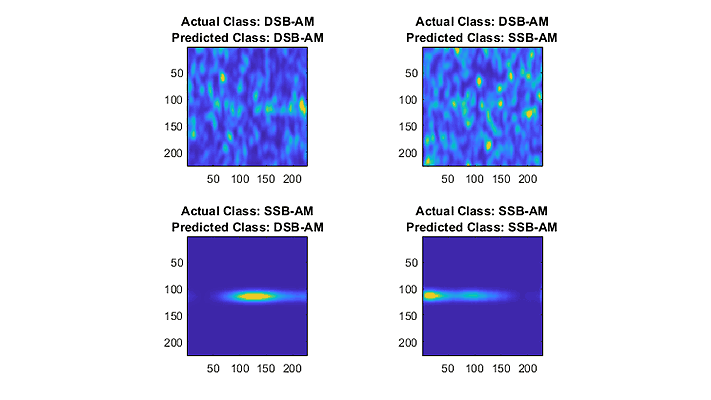
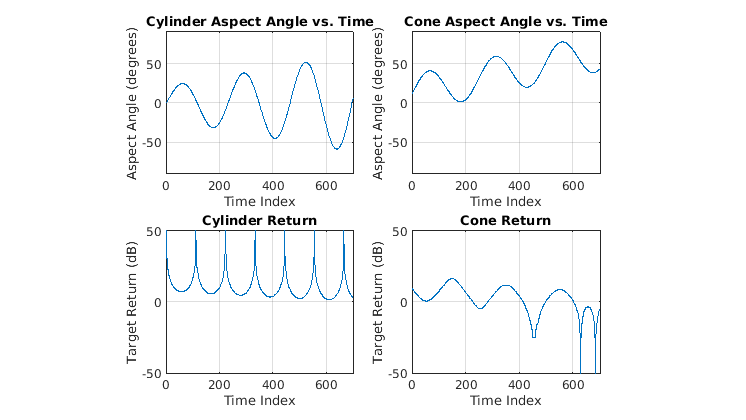
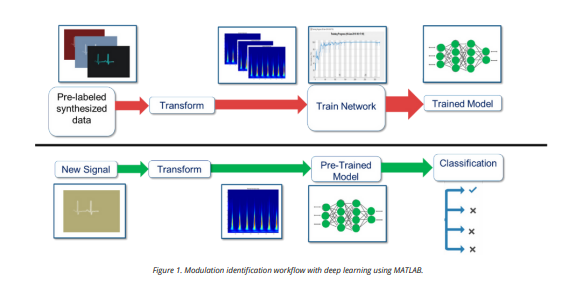
Waveform Classification and Spectrum SensingSynthesize and label radar waveforms to train deep learning networks. Extract time-frequency features from signals and perform waveform modulation classification using deep learning networks. Determine bandwidth of occupied signals. | | Radar Target ClassificationClassify radar returns based on radar cross sections with both machine and deep learning approaches. The machine learning approach uses wavelet scattering feature extraction coupled with a support vector machine. Two common deep learning approaches are transfer learning using SqueezeNet and a Long Short-Term Memory (LSTM) recurrent neural network. |
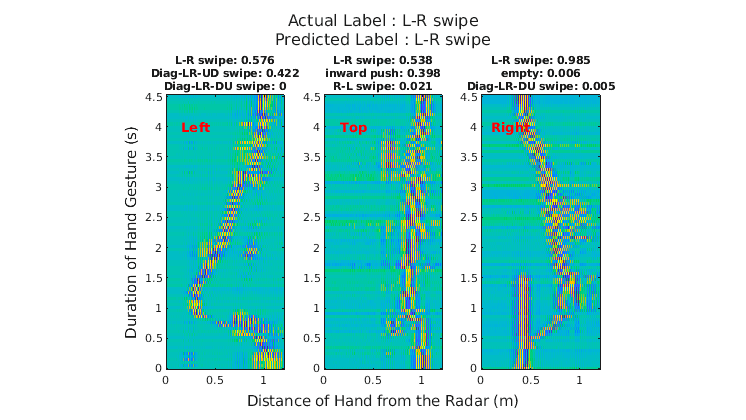
Hand Gesture ClassificationClassify ultra-wideband (UWB) impulse radar signal data from a publicly available dataset of dynamic hand gestures. Use a multiple-input, single-output convolutional neural network (CNN) where the CNN model extracts feature information from each signal before combining it to make a final gesture label prediction. | | Micro-Doppler Signature ClassificationClassify pedestrians and bicyclists based on their micro-Doppler characteristics using time-frequency analysis and a deep learning network. The movements of different parts of an object placed in front of a radar produce micro-Doppler signatures that can be used to identify the object. |
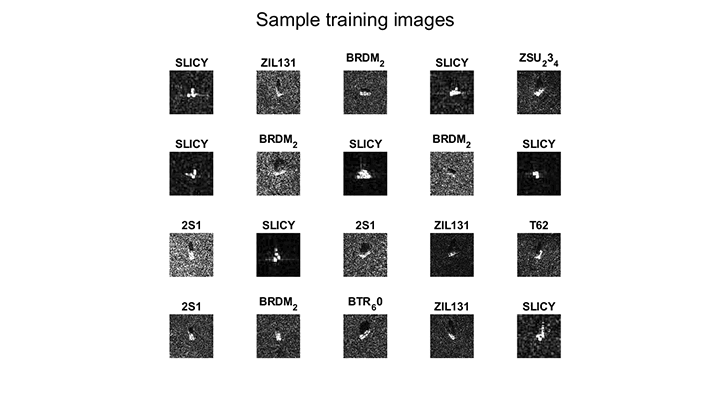
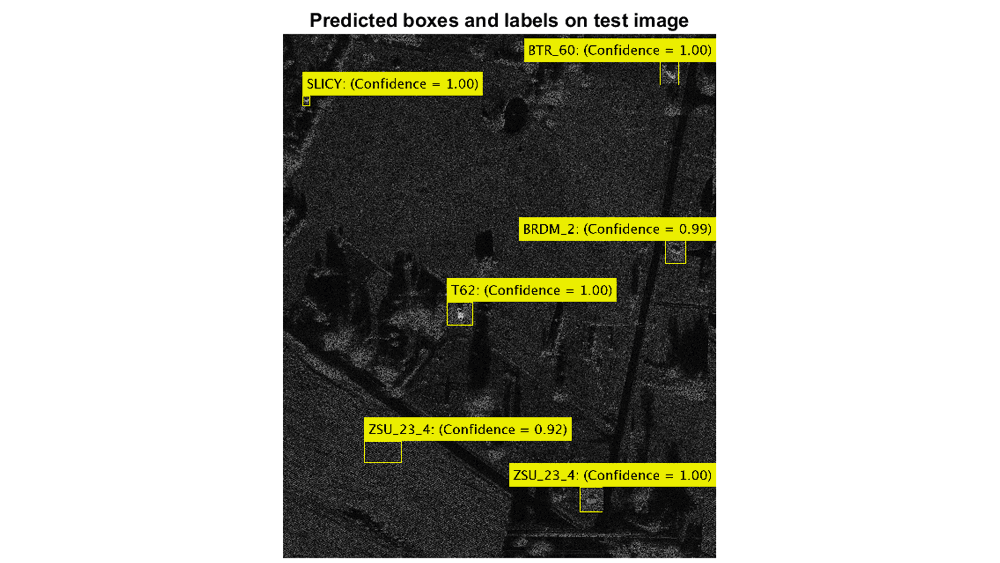
SAR Image ClassificationUse deep learning techniques for target classification of Synthetic Aperture Radar (SAR) images. Create and train a Convolution Neural Network (CNN) to classify SAR targets from the Moving and Stationary Target Acquisition and Recognition (MSTAR) Mixed Targets dataset. | | SAR Image RecognitionPerform target recognition of Synthetic Aperture Radar (SAR) images using a Region-based Convolutional Neural Networks (R-CNN). The R-CNN network integrates detection and recognition with efficient performance that scales to large scene SAR images. |
 VI
VI  EN
EN  TH
TH