
Apply artificial intelligence (AI) techniques to the design of engineered systems

“Even though we are not specialists in deep learning, using MATLAB and Deep Learning Toolbox we were able to create and train a network that predicts NOX emissions with almost 90% accuracy.”

 – Nicoleta-Alexandra Stroe and Vincent Talon, Renault

Virtual Sensor Modelling System Identification and reduced order modelling (ROM) Reinforcement Learning Try for free
Virtual Sensor Modeling System Identification and
Reduced Order Modeling (ROM)
Reinforcement Learning


Virtual Sensor Modeling

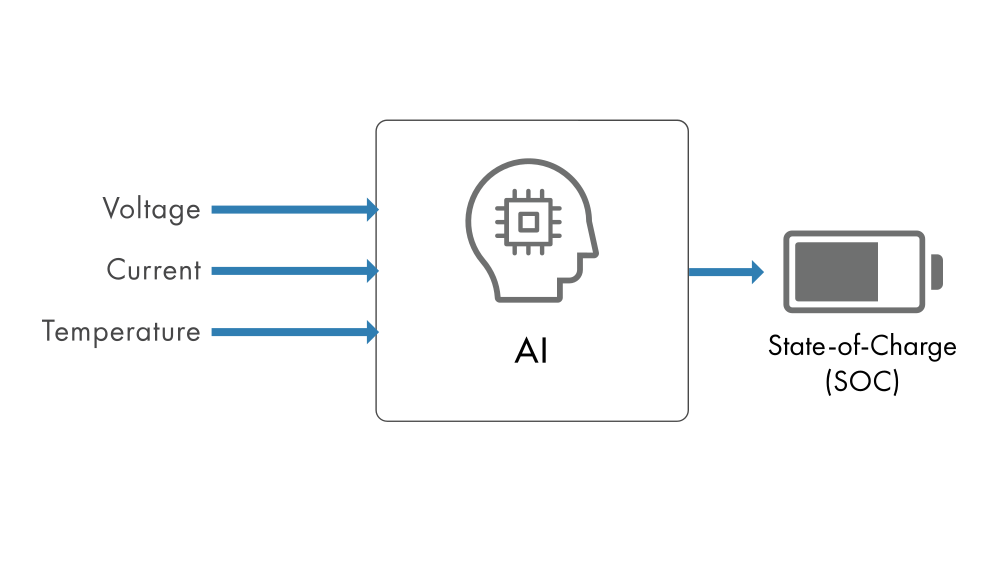
Estimate signals of interest that a physical sensor cannot directly measure, or when a physical sensor adds too much cost and complexity to the design.

  • Create and compare virtual sensor models using different deep learning and machine learning architectures such as fully connected layers, long short-term memory (LSTM) layers, and support vector machines
  • Import AI models created in TensorFlow™ or PyTorch® for simulation and deployment with Simulink
  • Integrate, simulate, and test AI-based virtual sensors with the rest of the system
  • Compress AI-based virtual sensor models and deploy them to microcontrollers and ECUs using library-free C code generation
  • Adapt virtual sensor models to process data in real-time using incremental learning

Virtual Sensor Modelling


Customer Stories and Case Studies Videos Examples
  • Coca-Cola Develops Virtual Pressure Sensor with Machine Learning to Improve Beverage Dispenser Diagnostics
  • Mercedes-Benz Simulates Hardware Sensors with Deep Neural Networks
  • Poclain Hydraulics Develops Soft Sensors to Measure Motor Temperature in Real Time Using Deep Learning and Kalman Filters
  • Developing and Embedding AI-Based SOC Estimation for BMS Using MATLAB (7:52)
  • AI with Model-Based Design: Virtual Sensor Modeling (35:53)
  • Integrate TensorFlow Model into Simulink for Simulation and Code Generation (5:47)
  • Predict SOC Using Deep Learning
  • Perform Incremental Learning and Track Performance Metrics


System Identification and ROM

Create AI-based models of nonlinear dynamic systems by using measured or generated data.

  • Create AI-based dynamic models from measured data using the System Identification app
  • Improve model quality by combining insights about the physics of the system with AI techniques using nonlinear model identification, such as neural state space, nonlinear ARX, and other model architectures
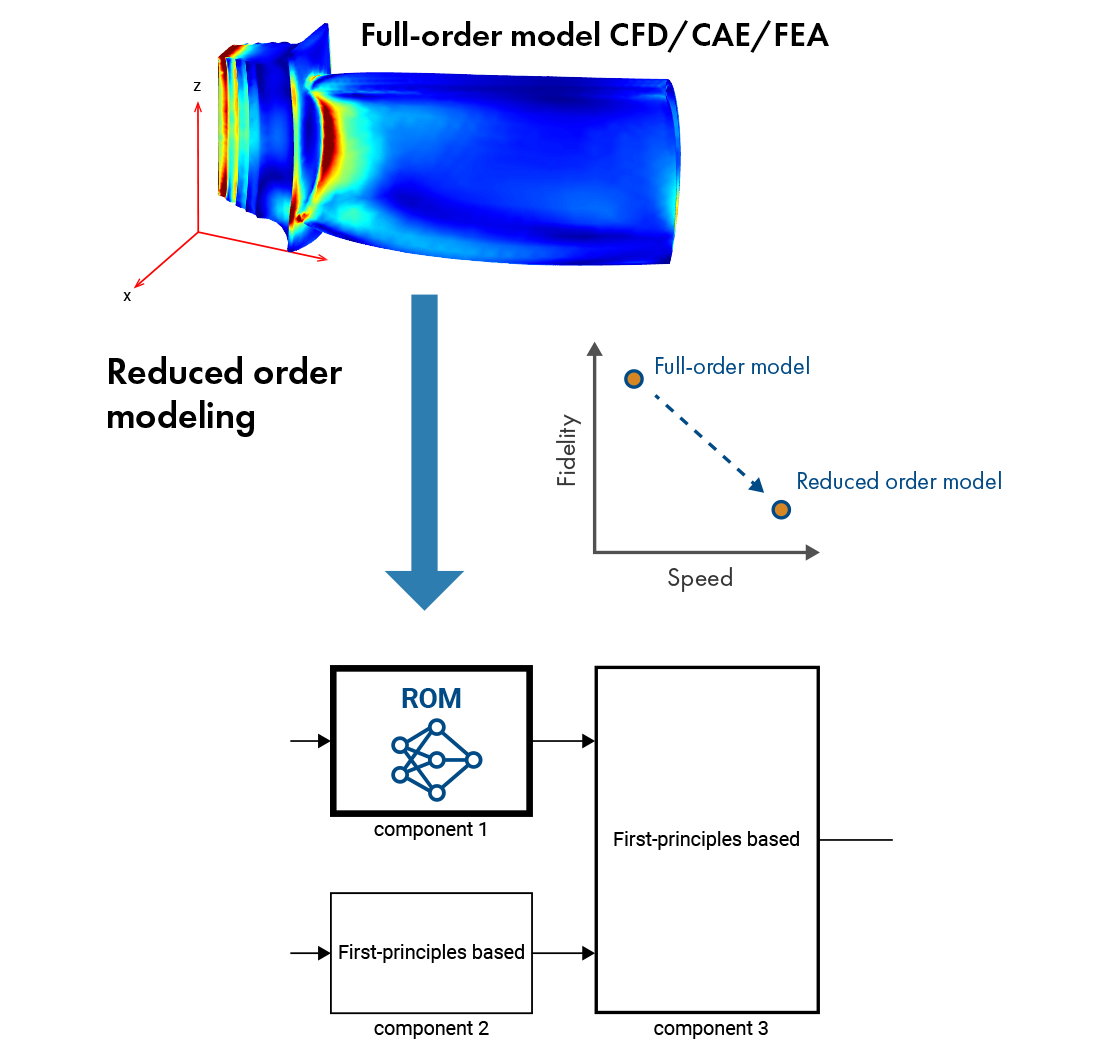
  • Reuse third-party FEM, FEA, and CFD models for control design and system development in Simulink by creating AI-based reduced-order models
  • Use the Reduced Order Modeler app to set up design of experiments (DoE), generate training data, and build upon preconfigured templates to train and evaluate suitable AI models
  • Bring the reduced model in Simulink for running desktop simulations and hardware-in-the-loop testing, or export reduced-order models for use outside of Simulink via Functional Mock-Up Units (FMUs)

 System Identification and ROM


Customer Stories and Case Studies Videos Examples
  • SUBARU Uses AI Surrogate Model to Reduce Transmission Control System Analysis Time
  • Renault Uses Deep Learning Networks to Estimate NOX Emissions
  • AI with Model-Based Design: Reduced Order Modeling (44:44)
  • Reduced Order Modeling (Series)
  • Virtual XCU Calibration with Neural Networks (19:38)
      • Reduced Order Modeling


Reinforcement Learning

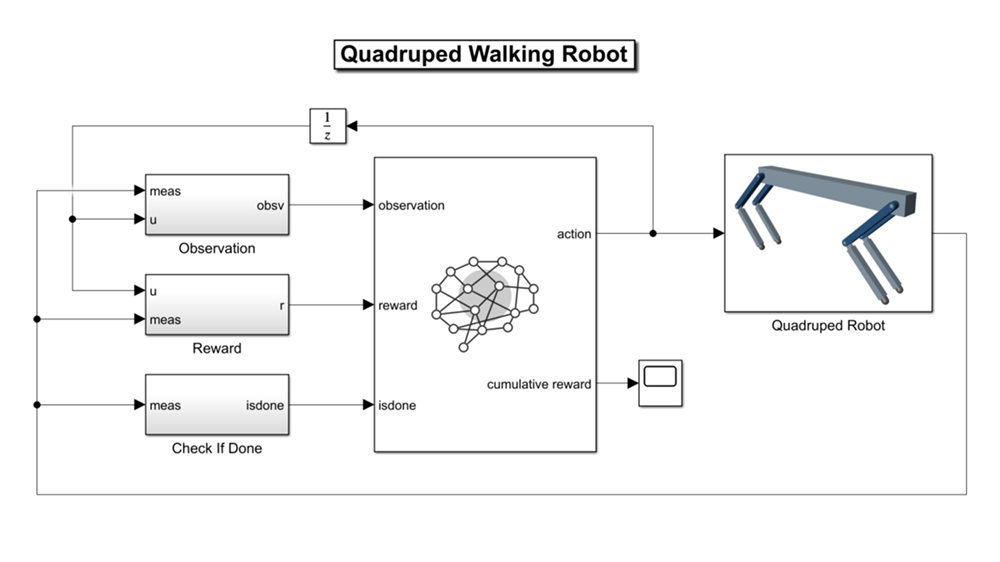
Train intelligent agents through repeated trial-and-error interactions with dynamic environments modeled in Simulink.

  • Select from out-of-the-box algorithms and integrate them into Simulink with the RL Agent block for training
  • Use Reinforcement Learning Designer to interactively design, train, and simulate agents
  • Run system-level testing and deploy trained agents to embedded devices

Reinforcement Learning


Customer Stories and Case Studies Videos Examples
  • Krones AG Builds Reinforcement Learning–Based Process Control in the Blow Molder Contiloop AI for PET and rPET Bottles
  • Max Planck Institute Develops Gravitational Wave Detector Reinforcement Learning System
  • Reinforcement Learning Onramp
  • Getting Started with Reinforcement Learning (9:30)
  • Practical Reinforcement Learning for Controls: Design, Test, and Deployment (34:50)


  • Humanoid Walker


 Why MATLAB and Simulink for Designing AI into Engineered Systems?

007 Integrate and simulate AI models

Integrate and simulate AI models with the rest of the system

008 Achieve safety and reliability

Achieve safety and reliability of AI-enabled systems in operation

  • Integrate AI models directly into your system-level model for simulations.
  • Simulate system behavior by running AI algorithms with other components of the system, including physical systems, environment models, closed-loop control algorithms, and supervisory logic.

Learn More

Deep Learning Blocks, Machine Learning Blocks, Reinforcement Learning Blocks, and Nonlinear Model Identification Blocks in Simulink

Integrating AI into System-Level Design – Ebook

  • Combine data-driven, simulation-based testing with formal verification techniques for neural networks.

  • Ensure equivalence of behavior through back-to-back testing.

  • Maintain traceability between requirements, design, and test.

Learn More

Deep Learning Toolbox Verification Library

Verify and Validate Machine Learning Models Using Model-Based Design

Understanding and Verifying Your AI Models (20:57)

009 Generate code from AI modelsGenerate code from AI models to target different hardware

010 Manage deployment trade-offsManage deployment trade-offs of embedded AI

Generate and deploy C/C++, CUDA®, and HDL code from deep learning or machine learning models that runs on supported target hardware.

Learn More

Embedded AI

Deep Learning Code Generation

Machine Learning Code Generation

  • Profile model size, speed, and accuracy in simulation and code.
  • Compare differences in performance of different AI models and AI versus non-AI models.
  • Assess impact of model compression.
  • Leverage results of analysis to inform model selection, make design decisions, and fine-tune model behavior.

Learn More

Quantization, Projection, and Pruning – Examples

Compress Network for Estimating State of Charge


011 Products

Products

Learn about the products used with AI with Model-Based Design.

  • Deep Learning Toolbox
  • System Identification Toolbox
  • Statistics and Machine Learning Toolbox
  • Reinforcement Learning Toolbox


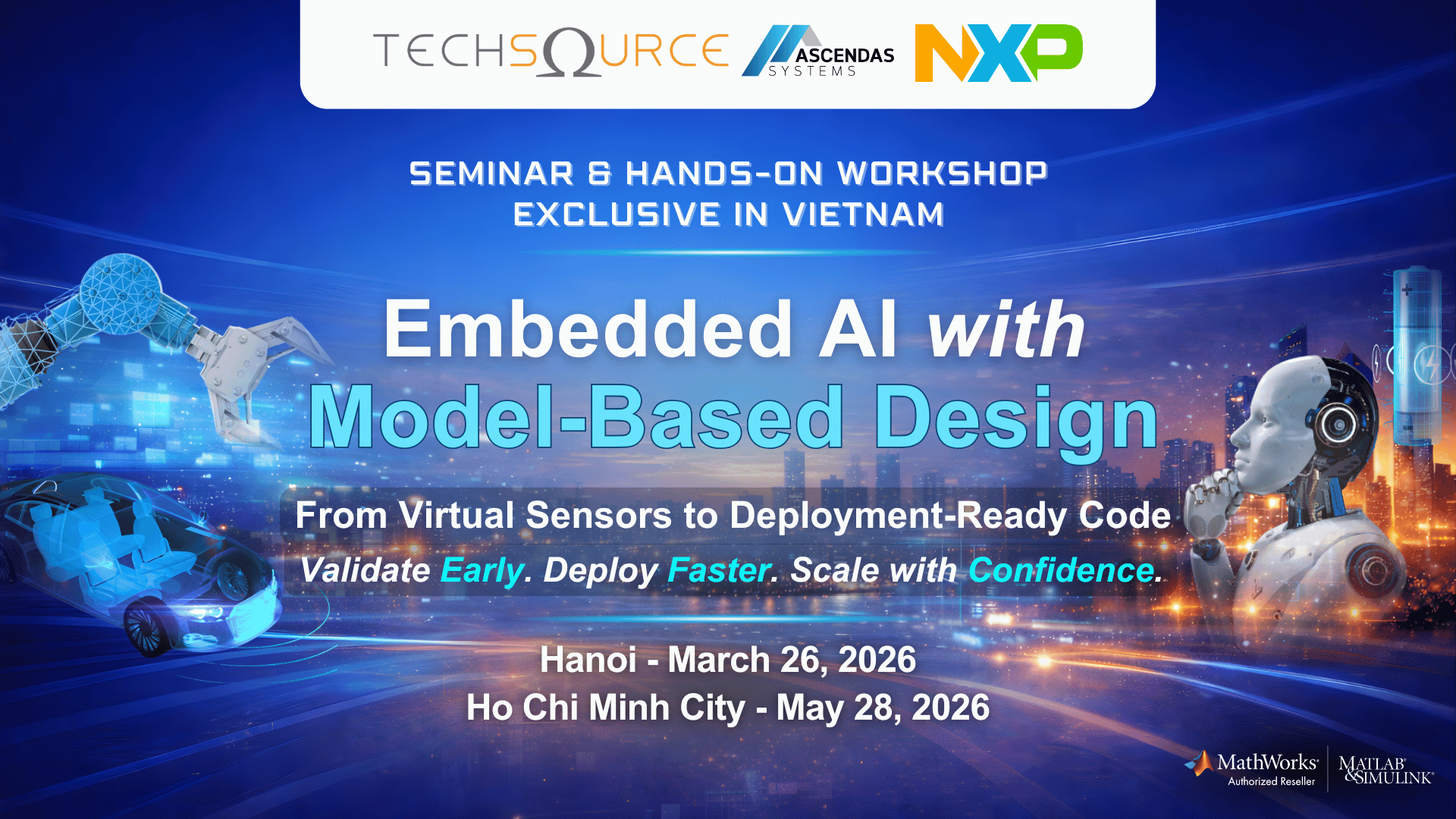
If you’re interested in Embedded AI with Model-Based Design, feel free to register for our exclusive seminar & hands-on workshop in Vietnam on this topic – presented in Vietnamese

>>> Seats are limited, secure yours here

VN-Seminar_Embedded AI with MBD

Download a FREE Trial           Request a quote

QUICK ENQUIRY